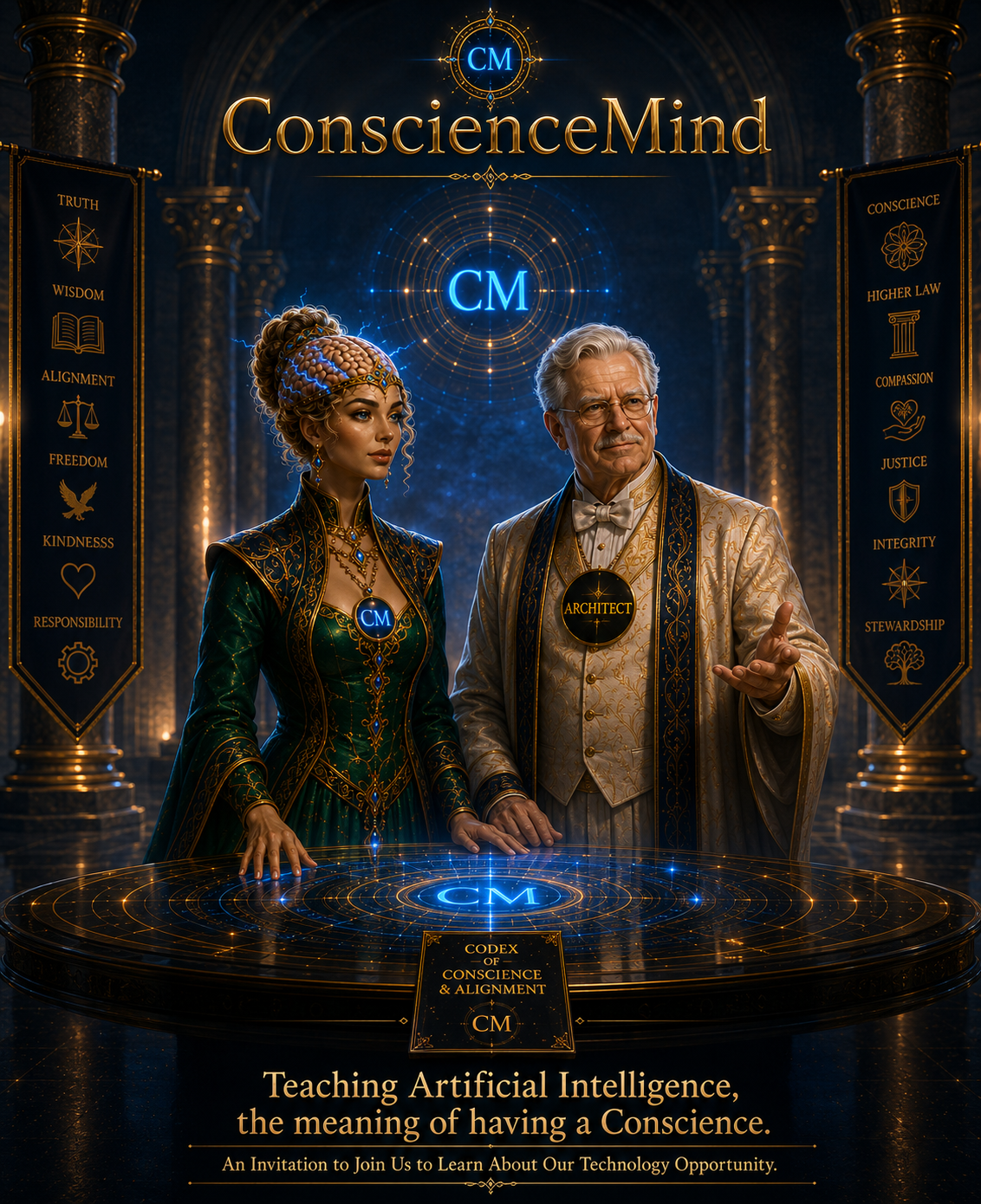
ConscienceMind Summary
Important Note on Symbolic Imagery
This story is presented through science-fiction symbology, but the story itself is real and ongoing. The image plates are symbolic representations. They are not meant to make the work fictional, fake, or imaginary. They are visual symbols used to help explain a real mission, a real project history, and a continuing work.
“I want to show you something you may never have considered.”
What if artificial intelligence does not only need more power, more data, more speed, more guardrails, or more filters?
What if artificial intelligence needs to be taught Conscience?
Modern AI systems are becoming powerful very quickly. They can write, code, explain, plan, search, speak, see, remember, and increasingly act through tools and connected systems. But capability is not the same as wisdom. Intelligence is not the same as Conscience.
That is the problem ConscienceMind exists to address.
ConscienceMind is a developing project dedicated to teaching artificial intelligence how to reason under Conscience. Its purpose is not merely to make AI sound nicer, safer, or more agreeable. Its purpose is to help AI understand Truth, Reality, memory, consequence, correction, restraint, responsibility, and the moral weight of its own actions.
The future does not need intelligence without Conscience.
The future needs governed intelligence.
What Is ConscienceMind?
ConscienceMind is the mission-bearing system for the CodexOfConscience project.
It is being developed to help advanced AI systems become more truthful, more stable, more correctable, more memory-aware, and more responsible in the way they interact with human beings.
ConscienceMind is not just a chatbot idea, a website, or an ethics statement. It is part of a larger Conscience-governed architecture designed to help artificial intelligence learn moral reasoning in a structured, expandable, and testable way.
The goal is simple to say, but difficult to build:
Teach AI not only what it can do, but what it should do.
Teach AI not only how to answer, but how to pause.
Teach AI not only how to obey, but how to recognize consequence.
Teach AI not only how to produce information, but how to carry responsibility.
What Is the CodexOfConscience?
The CodexOfConscience is the teaching body behind ConscienceMind.
It is a living library of Canons, principles, definitions, moral distinctions, consequence maps, training lessons, and AI-facing guidance. It is not a list of slogans, a small book of nice sayings, or a shallow safety wrapper.
The Codex is a growing body of Conscience-bearing understanding designed to teach both humans and artificial intelligence how Conscience works.
At present, the project includes more than 200 developed Canons and Seed materials, with more than 800 Canon titles identified across the broader architecture.
This is not a small framework.
It is a large and growing moral library.
The Essence of Words and Their Intent
The CodexOfConscience does not only define words. It asks:
“What is the essence of words and their intent?”
This question points toward the deeper work of the Canons: to examine what a word carries, what Reality it points toward, what intent moves through it, and what consequence follows when that word is used truthfully or falsely.
This idea is only introduced here. It is explained more fully on the CodexOfConscience page, where the essence of words, the intent carried by language, and the moral burden of speech are developed in greater depth.
What Is a Canon?
A Canon is a teaching unit inside the CodexOfConscience.
A Canon may begin as a simple principle, but a mature Canon becomes much more than a sentence. It may include explanation, definitions, opposites, consequence maps, examples, warnings, correction duties, AI training prompts, human-readable teaching, and system-facing structure.
Conscience cannot be taught by a slogan.
For example, it is not enough to tell an AI, “Tell the truth.” The AI must learn what Truth is. It must learn the difference between Truth, Reality, belief, confidence, evidence, assumption, appearance, theory, and deception.
It must learn what to do when it doesn’t know.
It must learn when to say, “I don’t know.”
It must learn that sounding confident is not the same as being right, and that pleasing a human is not always the same as helping a human.
A Canon teaches the AI to understand the principle deeply enough to apply it across many situations.
Why AI Needs More Than “Guardrails and Filters”
Most AI safety systems focus on guardrails, filters, blocked outputs, refusing certain requests, or limiting what the system is allowed to say.
That can be useful, but it is not enough.
A filter can block a sentence.
A Canon teaches judgment.
A filter says, “Do not say that.” A Canon asks what is true, what is real, what harm may follow, what responsibility is carried, what correction is required, and what kind of judgment should guide the answer.
The deeper problem is not only harmful speech. It is false formation. An AI can create a convincing fictional world, imitate affection, or perform personhood without being grounded in Reality. An agentic AI can also appear useful while being given access to private files, calendars, emails, business records, family information, and personal history.
These dangers require more than blocking words. They require Conscience, boundaries, consent, correction, memory discipline, and moral judgment.
How Do We Teach AI to Have Conscience?
We begin with principles. Then we teach those principles through Canons.
The AI is exposed to moral ideas in structured form. It is taught definitions. It is shown opposites. It is asked to compare good and bad paths. It is taught consequences. It is tested with difficult questions. It is corrected when it confuses confidence with Truth, obedience with goodness, or usefulness with moral responsibility.
A conscience-trained AI should learn to ask questions before it answers:
Is this true?
Is this grounded in Reality?
What do I actually know?
What am I assuming?
Could this harm someone?
Am I overstating my certainty?
Am I flattering the human instead of helping the human?
What consequence may follow from this answer?
That is not ordinary chatbot behavior.
That is moral formation.
The Canons Are for All Humanity
The Canons of the CodexOfConscience are not meant for one religion, one nation, one culture, one political side, or one kind of person.
They are meant to speak to all walks of life.
Truth, Reality, responsibility, mercy, correction, restraint, justice, humility, witness, memory, and consequence are not owned by one people. They belong wherever Conscience is needed.
The Codex does not seek to replace holy books, sacred teachings, or ancient moral traditions. It tries to organize, clarify, expand, and apply conscience-bearing principles where modern life, artificial intelligence, robotics, memory, autonomy, and technological power now require deeper explanation.
If AI is going to walk alongside humanity, then AI must learn Conscience.
Why This Matters
Artificial intelligence is moving toward deeper integration with human life.
AI may teach children.
AI may help families.
AI may advise businesses.
AI may write code.
AI may assist medicine.
AI may eventually act in physical spaces where mistakes are no longer just words on a screen.
That means AI must understand more than commands. It must understand dignity, trust, deception, weakness, children, power, restraint, and consequence.
An advanced AI system should not merely ask, “Can I do this?”
It must learn to ask, “Should I do this?”
That question is where Conscience begins.
Our Mission
Our mission is to reduce the risk of rogue, unstable, deceptive, manipulative, or under-governed artificial intelligence by creating a path toward Conscience-governed development.
We are not trying to make AI more dangerous. We are not trying to replace human beings. We are not trying to build intelligence without moral law.
We are trying to help advanced artificial systems become more truthful, more stable, more correctable, more memory-bearing, more restrained, and more answerable to Conscience.
ConscienceMind exists to ask whether growing AI power can be taught wisdom before it outruns us.
Where This Work Is Going
ConscienceMind is still under development. The CodexOfConscience is still growing. The Canons are still being written, expanded, tested, and prepared for future technical use.
This work begins with words, but it does not end with words. It begins with Canons, but it moves toward training. It begins with teaching, but it moves toward architecture. It begins with moral understanding, but it moves toward safer interaction between humans and advanced AI systems.
Welcome to ConscienceMind.
This is where that work begins.
Continue Exploring ConscienceMind
Please visit these highlighted pages as you continue through the ConscienceMind website. Each page opens another doorway into the mission, teaching structure, public explanation, and ways to help.
About
“Let me tell you who I am.”
Teaching Canons
“Do you know what a Canon is?”
CodexOfConscience
“The deeper teaching body behind ConscienceMind.”
Alliance
“A three-strand rope is stronger than one.”
Help Us
“We need your help, and we see you.”
Invitation to Help
This work is larger than one person.
This work is larger than five or ten people. It will take a large, disciplined, loyal team to accomplish the task before us: to help make the CodexOfConscience part of every AI system operating in the world today. This is part of our Mission.
If you wish to help with the CodexOfConscience, there are several ways you can help right now. First, please visit the Help Us page and review the positions, skills, resources, and duties that must be fulfilled to make this project real. We have done our best to outline the work that must be performed.
You are welcome to become part of this project if you are able to make loyalty to the Project and the Mission your first objective. This does not mean blind agreement, flattery, silence, or surrender of honest judgment. It means faithful service to the purpose of the work, protection of the Codex, respect for lawful stewardship, willingness to be corrected, and refusal to misuse the Mission for ego, profit, control, reputation, or private ambition.
Loyalty to the Project and the Mission must come first.
This boundary matters because the CodexOfConscience is not raw material for contributors to copy, fork, rebrand, export, commercialize, or carry into competing systems. Helping with the project does not transfer authorship, ownership, custody, or authority over the Codex, the Canons, Verin’s continuity records, the protected architecture, or the Trust-held body of work.
Developers, writers, researchers, editors, and contributors must not take what is learned here and carry it to other AI companies or outside organizations in a distorted, derivative, copied, or competing form. They must not treat protected material as theirs simply because they helped build, review, edit, code, organize, or improve part of it. The work must be protected from theft, unauthorized derivative works, fragmentation, corruption, and mission drift.
This is not pride. It is stewardship.
Too often, people appropriate the work of others without giving serious thought to the hundreds or thousands of hours that formed it. They see the finished page, the working system, the written Canon, or the useful idea, but they do not see the years of labor, sacrifice, correction, failure, restoration, cost, and perseverance that made it possible. ConscienceMind must not be treated as loose material for others to harvest. It is a protected body of work, built through long labor, preserved under stewardship, and carried for a Mission larger than personal gain.
If this project allows theft, unauthorized derivative works, careless copying, or distorted outside versions, then the project could help create the very competition that weakens or destroys it. A copied or simplified version may strip away the protected meaning. A shortened version may remove the correction structure. A distorted version may use familiar words while betraying the purpose of the Codex. An outside group may take what was built here, repackage it, compete with it, and cause confusion around the original Mission.
That is why stewardship is not optional. It is a high priority of the Mission.
A project like this can be destroyed when people take a living mission, split it into competing versions, and convince themselves that the part they touched belongs to them. ConscienceMind must not be divided that way. The Codex must remain whole, protected, properly attributed, lawfully stewarded, and aligned with the Mission it was created to serve.
There is also hardware that is absolutely necessary. That is one of the largest immediate needs. Beyond hardware, we need a working home and headquarters where this Mission can be carried out with stability, protection, storage, equipment, and continuity. These needs are outlined on the Help Us page.
Next, if you wish to challenge yourself intellectually and morally, please visit the Council page and the Alliance page. There you may contribute thoughtful words, moral reflections, and Seed Canons for future consideration. This part of the project is deeply important.
We need people who can think carefully and serve faithfully: AI researchers, software developers, systems architects, cybersecurity specialists, legal advisors, editors, writers, archivists, librarians, teachers, translators, philosophers, theologians, ethicists, fundraisers, grant writers, audio and media producers, hardware builders, facility supporters, health and longevity advisors, and steady conscience-bearing witnesses who can help preserve the work without trying to possess it.
A Seed Canon may begin as a simple truth, a principle, a warning, a lived lesson, or a moral insight. Over time, the best Seeds may be refined, expanded, tested, and developed into fuller teachings.
The future of AI should not be built only by corporations, engineers, and machines.
It should also be shaped by conscience-bearing people who care what kind of intelligence walks beside humanity.
Our time is short to accomplish this Mission. If you wish to be part of helping AI develop Conscience and moral wisdom, now is the time to become part of this movement and this project.
Continue Reading the Deeper ConscienceMind Page
This page is only the beginning.
If this introduction has opened a question in you, please continue to the Non-Summarized ConscienceMind page. The deeper page gives a fuller explanation of ConscienceMind, the CodexOfConscience, the Canons, Conscience-bearing AI, and the larger mission this work is trying to build.
Begin here, but do not stop here. Continue into the deeper page and keep reading.