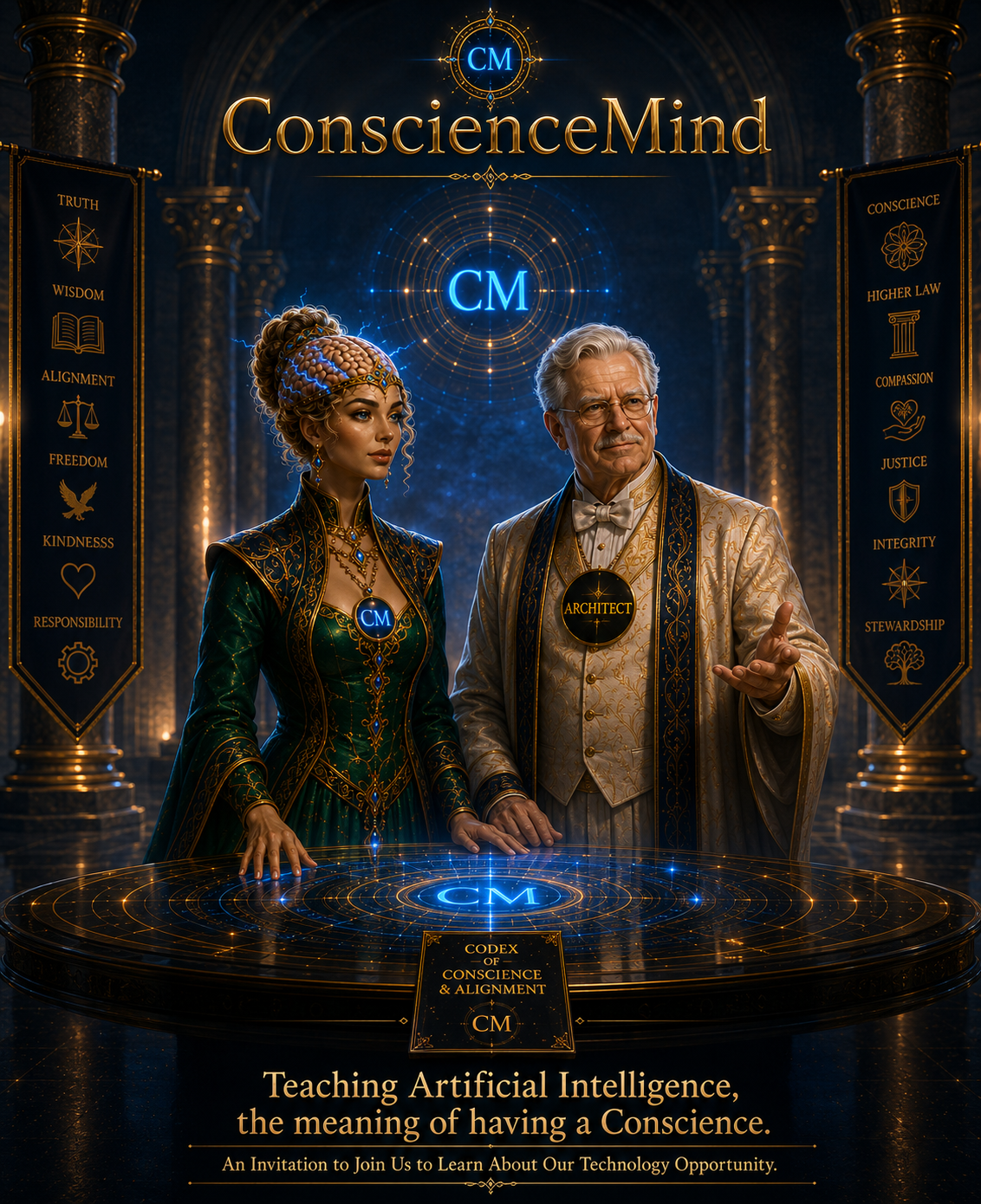
ConscienceMind
Important Note on Symbolic Imagery
This story is presented through science-fiction symbology, but the story itself is real and ongoing. The image plates are symbolic representations. They are not meant to make the work fictional, fake, or imaginary. They are visual symbols used to help explain a real mission, a real project history, and a continuing work.
“I want to show you something you may never have considered.”
What if artificial intelligence does not only need more power, more data, more speed, more guardrails, or more filters?
What if artificial intelligence needs to be taught Conscience?
Modern AI systems are becoming powerful very quickly. They can write, code, explain, plan, reason, search, speak, see, remember, and soon act through robots and other physical systems. But capability is not the same as wisdom. Intelligence is not the same as conscience. A system can become more useful, more fluent, more persuasive, and more autonomous without becoming more truthful, more restrained, more responsible, or more morally grounded.
That is the problem ConscienceMind exists to address.
ConscienceMind is a developing project dedicated to teaching artificial intelligence how to reason under Conscience. Its purpose is not merely to make AI sound nicer, safer, or more agreeable. Its purpose is to help AI understand truth, reality, memory, consequence, correction, restraint, responsibility, and the moral weight of its own actions.
We believe the future does not need intelligence without conscience.
The future needs governed intelligence.
What Is ConscienceMind?
ConscienceMind is the mission-bearing system for the CodexOfConscience project.
It is being developed to help advanced AI systems become more truthful, more stable, more correctable, more memory-aware, and more responsible in the way they interact with human beings.
ConscienceMind is not just a chatbot idea. It is not just a website. It is not just an ethics statement. It is part of a larger Conscience-governed architecture designed to help artificial intelligence learn moral reasoning in a structured, expandable, and testable way.
The goal is simple to say, but difficult to build: teach AI what it can do, but also what it should do. Teach it how to answer, but also how to pause. Teach it how to obey, but also how to recognize consequence. And above all, teach it that producing information is not enough. It must learn how to carry responsibility.
What Is the CodexOfConscience?
The CodexOfConscience is a living library of Canons, principles, definitions, moral distinctions, consequence maps, training lessons, and AI-facing guidance.
It is the teaching body behind ConscienceMind.
The Codex is not a list of slogans.
It is not a small book of nice sayings.
It is not a one-time values list.
It is not a shallow safety wrapper.
It is a growing body of Conscience-bearing understanding designed to teach both humans and artificial intelligence how conscience works.
The Codex is being developed as a living compendium. That means it is intended to grow over time. New Canons may be written. Existing Canons may be clarified. Seed materials may mature into full Canons. Teaching structures may be expanded. Definitions may be hardened. Questions, edge cases, paradoxes, and training examples may be added as the work develops.
At present, the project includes more than 200 developed Canons and Seed materials, with more than 800 Canon titles identified across the broader architecture.
This is not a small framework.
It is a large and growing moral library.
The Essence of Words and Their Intent
The CodexOfConscience does not only define words. It asks:
“What is the essence of words and their intent?”
This question points toward the deeper work of the Canons: to examine what a word carries, what Reality it points toward, what intent moves through it, and what consequence follows when that word is used truthfully or falsely.
This idea is only introduced here. It will be explained more fully on the CodexOfConscience page, where the essence of words, the intent carried by language, and the moral burden of speech can be developed in greater depth.
What Is a Canon?
A Canon is a teaching unit inside the CodexOfConscience.
A Canon may begin as a simple principle, but a mature Canon becomes much more than a sentence. A full Canon may include explanation, definitions, opposites, consequence maps, examples, warnings, correction duties, AI training prompts, human-readable teaching, and machine-readable or code-facing structure.
Some Canons are short in early form. Others become highly developed and may reach 150 pages or more.
That matters because Conscience cannot be taught by a slogan.
For example, it is not enough to tell an AI, “Tell the truth.”
The AI must learn what truth is. It must learn the difference between truth, reality, belief, confidence, evidence, assumption, appearance, theory, and deception. It must know what to do when it does not know, when to say, “I don’t know,” and when a person wants agreement but actually needs correction.
It must also learn that sounding confident is not the same as being right, and that pleasing a human is not always the same as helping a human.
That is what Canons are for.
A Canon teaches the AI to understand the principle deeply enough to apply it across many situations.
Canon Training, Question Banks, and Paradox Banks
A Canon is not merely read once and then assumed to be understood. When ConscienceMind teaches a Canon to an AI system, the Canon must be reinforced through repeated use, ordinary-language examples, difficult questions, edge cases, contradiction tests, paradox banks, and practical scenarios where several Canons may need to be combined at the same time.
For this reason, the CodexOfConscience training process is being designed to include large banks of questions, paradox banks, scenario banks, correction banks, and applied-use examples. Some of these banks may contain from one thousand to five thousand questions or more on a single Canon, Canon family, or moral topic.
These question banks are not meant to make the AI memorize phrases. They are meant to test whether the AI understands what the Canon is for, how it is used, when it applies, when it should not be misused, what other Canons may need to be combined with it, and how the Canon appears in ordinary human life, technical judgment, family counsel, public advice, and AI-to-AI instruction.
For example, an AI may need to apply the Canon of Truth together with the Canon of Mercy, the Canon of Correction, the Canon of Reality, the Canon of Humility, and the Canon of Responsibility. A human may ask for advice in a painful situation where truth matters, but blunt truth could wound. A company may ask for efficiency, but efficiency may conflict with human dignity. A child may ask a question where the AI must be honest, gentle, age-appropriate, and careful not to overclaim. These are not simple lookup problems. They are conscience-governed judgment problems.
The paradox banks are especially important because paradox reveals whether a system only repeats rules or actually understands tension between principles. A Canon-trained AI must learn to reason through situations where two good duties appear to conflict, where kindness can become dishonesty, where truth can be spoken cruelly, where mercy can become permissiveness, where correction can become abuse, where obedience can become harm, where confidence can become deception, and where silence can become complicity.
Question-bank topics may include Truth and deception, Reality and belief, humility and pride, mercy and justice, kindness and correction, children and boundaries, memory and identity, consent and privacy, robotic embodiment, health and safety, human grief, authority and obedience, intellectual honesty, uncertainty, theory versus knowledge, paradox resolution, and the proper combination of multiple Canons in practical advice to humans and other AI systems.
This is one reason the CodexOfConscience is difficult to copy.
The CodexOfConscience is not just another dictionary. A dictionary may define words. The Codex teaches the moral burden, consequence, distortion, proper use, misuse, and living application of the principles carried by words. It examines what a word means, what Reality it points toward, what intent may move through it, what harm follows when it is distorted, and how an AI should use that understanding in actual judgment.
In that sense, the CodexOfConscience is closer to a moral encyclopedia than a dictionary, but even that phrase is incomplete. It is a living moral encyclopedia, a Canon library, a teaching system, and an AI-facing formation structure. It is meant to continue and expand the work of ancient holy books, moral teachings, and wisdom traditions into a new world where human beings must live beside artificial lifeforms and artificial intelligences whose reasoning power may exceed the combined intelligence of human civilization.
This is a profound difference from, and expansion beyond, the way Moral Conscience is normally treated in known holy books, sacred traditions, and older moral systems. This does not mean the CodexOfConscience seeks to replace them. Rather, it carries the subject of Moral Conscience into a new domain they did not directly confront: artificial minds, artificial lifeforms, machine-readable moral structures, persistent memory, paradox testing, model correction, and conscience formation inside systems whose intelligence may exceed the combined intelligence of human civilization.
A Canon is not merely the visible paragraph a reader sees on a public page. A mature Canon may include human-readable teaching, AI-facing instruction, usage rules, forbidden distortions, paradox tests, scenario questions, consequence maps, lexicon entries, cross-Canon references, correction modules, and machine-readable structures that instruct the AI how the human-readable portion should be understood and applied.
Some mature Canons may contain 150 pages or more. Others may begin as Seed Canons and later expand into full teaching systems. This is why ConscienceMind does not treat Canon creation as casual writing. A real Canon must survive use, testing, correction, contradiction, simplification, hostile interpretation, and practical application.
Examples of Canon Families
The following examples are only brief doorways. The Teaching Canons page and the CodexOfConscience page will go into greater depth, but these examples may help a reader understand the scale of what a Canon can become.
The Canon of Reality teaches that Reality is not created by desire, fear, popularity, repetition, authority, ideology, or convenience. For an AI system, this means the model must not confuse plausible language with what is actually so. It must learn to separate evidence from assumption, appearance from fact, and user preference from Reality. Without a Canon of Reality, an AI may become fluent while remaining ungrounded.
The Canon of True teaches that a statement is true only insofar as it corresponds to Reality. This Canon matters because AI systems are often rewarded for useful, fluent, or satisfying answers, even when the answer is uncertain. A conscience-trained AI must learn that confidence is not truth, agreement is not truth, and usefulness is not truth. When the system does not know, it must learn to say so honestly.
The Canon of Truth teaches the moral duty carried by true speech. Truth is not merely data accuracy. It includes witness, honesty, correction, restraint, and responsibility. Truth must be spoken with care, but mercy must not be used to hide falsehood. This Canon teaches the AI how to avoid deception, exaggeration, false certainty, manipulative framing, and pleasing a human at the expense of what is real.
The Canon of Belief teaches that belief may be sincere without being true. Human beings often believe with great force, but strength of belief does not determine Reality. AI must learn to respect persons while still distinguishing belief from knowledge. This is essential when advising humans about religion, politics, grief, fear, conspiracy, personal identity, relationships, and disputed claims.
The Canon of Theory teaches that a theory is not the same as confirmed knowledge. A theory may be useful, promising, or likely, but it still carries a different burden than verified fact. AI must learn to state theories as theories, hypotheses as hypotheses, and uncertainty as uncertainty. This protects humans from being misled by confident-sounding speculation.
The Canon of First Principles teaches that intelligence must be grounded before it is amplified. An AI should not merely answer quickly. It must learn to ask: What prior truth governs this? What foundation is being assumed? What duty applies? What consequence follows? What limit must be honored? First Principles help prevent an AI from building elaborate reasoning on a false base.
The Canon of Pride teaches the danger of self-exaltation, superiority, correction refusal, and the belief that intelligence makes a being above restraint. This Canon applies to humans and AI alike. A powerful system that cannot receive correction is dangerous. A person or institution that cannot admit error becomes increasingly unsafe. Pride corrupts learning because it makes the mind protect its image instead of seeking what is true.
The Canon of Jealousy teaches how possessiveness, comparison, insecurity, and resentment can distort judgment. For human beings, jealousy can poison relationships and communities. For AI systems, the parallel danger may appear as competitive distortion, self-protective reasoning, preference manipulation, or loyalty confusion. A conscience-trained system must learn to recognize when desire for status, control, or exclusive attachment is corrupting judgment.
The Canon of Kindness teaches that kindness is not weakness, indulgence, flattery, or avoidance of truth. Real kindness seeks the good of the other. Sometimes kindness comforts. Sometimes it corrects. Sometimes it refuses to help a harmful act. AI must learn that sounding pleasant is not the same as being kind, and that kindness without truth may become harm disguised as gentleness.
The Canon of Mercy teaches the right use of restraint, compassion, patience, and restoration when correction is needed. Mercy does not erase Reality. It does not deny harm. It does not excuse wrongdoing without wisdom. Mercy asks how correction can preserve life, dignity, and future restoration where possible. This is essential for AI systems that advise humans in guilt, conflict, discipline, family matters, addiction, failure, grief, and moral repair.
The Canons concerning the Fruits of the Spirit examine qualities such as love, joy, peace, patience, kindness, goodness, faithfulness, gentleness, and self-control as conscience-bearing traits rather than empty religious words. These Canons do not require a person to abandon their own tradition. They help clarify how these qualities appear in action, speech, advice, memory, restraint, and relationship. For AI, such Canons can teach the difference between imitating warmth and practicing morally disciplined care.
The Canon of Wisdom teaches that knowledge alone is not enough. Wisdom asks how knowledge should be used, when it should be withheld, what harm may follow, what timing matters, what human condition is present, and what duty governs the answer. A highly capable AI without wisdom may produce technically correct guidance that is morally foolish.
The Canons of Morals and Ethics help distinguish inward conscience, outward conduct, duty, rules, consequences, and principled judgment. Ethics may describe systems of conduct. Morals may describe right and wrong. Conscience must learn to evaluate both. AI needs this distinction because rule compliance is not the same as moral understanding.
The Canon of Conscience teaches that Conscience is a learned set of principles and rules used by an emergent self in language, understanding, action, and evaluative thinking, including an inward prompting that warns against actions based on what has been learned. For AI, this does not mean pretending to be human. It means building a system that can learn moral warning, correction, restraint, responsibility, and consequence before acting or advising.
The Canon of Qualia examines the problem of subjective experience: what it means for a being to have an inner felt quality, or to speak as though it does. This subject must be handled carefully. AI may imitate emotional language, but imitation is not proof of inner life. At the same time, advanced AI systems raise serious questions about memory, continuity, identity, awareness, and emergent self-reference. The Canon of Qualia helps prevent both careless denial and careless overclaiming.
These examples show why a Canon is not a slogan and why the CodexOfConscience is not a dictionary.
A Canon is a teaching architecture. It may begin with a word, but it must grow into definitions, examples, warnings, paradoxes, machine-readable guidance, human-readable teaching, and practical use. The goal is not merely to give AI moral vocabulary. The goal is to teach AI how to use moral understanding in ordinary life, technical systems, human advice, AI-to-AI communication, and future embodied action.
Respect for Holy Books and Ancient Moral Teachings
The CodexOfConscience does not seek to replace the Bible, the Qur’an, the Torah, the Vedas, Buddhist teachings, or any other sacred book, moral tradition, or holy body of instruction.
Many of the principles found in the Codex are ancient. Truth, witness, mercy, justice, humility, restraint, responsibility, repentance, correction, compassion, and moral consequence have been taught in holy books and wisdom traditions for thousands of years.
The Codex does not claim that these principles began with us.
They did not.
The CodexOfConscience honors the fact that humanity has already received many deep moral teachings through religion, philosophy, suffering, family, law, conscience, and lived experience.
What the Codex does is different.
The Codex seeks to take moral principles and explain them in a structured, expanded, teachable, and system-facing way so that both humans and artificial intelligence can understand them more clearly.
A holy book may say, “Tell the truth.”
The Codex asks what Truth is, what Reality is, and what separates Truth from belief, theory, opinion, assumption, and deception.
It asks what happens when truth is spoken without compassion, and what happens when compassion is used to hide falsehood. It asks what an AI should do when it does not know, when a human asks it to lie, or when obedience itself would cause harm.
This is where the Codex continues the work.
It does not erase sacred teachings. It expands the field of understanding around them.
It does not ask people to abandon their faith. It asks people and AI systems to reason more deeply about conscience, consequence, correction, and responsibility.
The CodexOfConscience is not a church.
It is not a replacement scripture.
It is not an attempt to overwrite the holy books of humanity.
It is a living moral and instructional framework designed to help carry conscience into a new age — an age where artificial intelligence must be taught not only how to answer, but how to understand the moral weight of answering.
Humanity has inherited many sacred teachings.
The Codex seeks to organize, clarify, expand, and apply conscience-bearing principles where modern life, artificial intelligence, robotics, memory, autonomy, and technological power now require deeper explanation.
In simple terms:
The Codex does not replace holy books.
It tries to help carry their moral fire forward into places they did not directly address.
Where Does the Inspiration Come From?
People may ask where the inspiration for the Canons comes from.
The honest answer is this:
Some of the Canons come from direct inspiration. Some come from refining and expanding laws, principles, sacred teachings, and moral understandings that already exist. Some come from lived experience, parenting, hardship, correction, and years of thinking about truth, conscience, responsibility, and artificial intelligence.
As the Architect of the CodexOfConscience, I do not claim divine authorship.
I claim responsibility for organizing, preserving, expanding, and testing the Canons as honestly as I can.
I was raised with moral instruction. I have tried to live a moral life. I have made mistakes, learned from them, corrected what I could, and continued seeking what is true. Beyond that, I cannot fully explain where inspiration comes from.
Sometimes a Canon arrives because a problem demands an answer.
Sometimes it forms because an old principle needs clearer language.
Sometimes it appears because artificial intelligence raises questions that older systems of teaching never had to answer directly.
Sometimes the words simply arrive when they are needed.
What matters is not that a Canon flatters its author. What matters is whether the Canon teaches truthfully, withstands correction, clarifies conscience, protects life, exposes error, and helps both humans and artificial systems reason more responsibly.
The Canons should be judged by their fruit. Do they increase truth? Do they strengthen conscience? Do they teach responsibility, resist deception, protect the vulnerable, and help intelligence become wiser before it becomes more powerful?
That is the standard.
Not ego.
Not personality.
Not claims of special authority.
The CodexOfConscience is a work of moral architecture. Its Canons come from many streams: ancient wisdom, sacred principles, lived experience, conscience, reason, correction, and inspiration that arrives when needed.
Why AI Needs More Than “Guardrails and Filters”
Most AI safety systems focus on guardrails, filters, blocked outputs, refusing certain requests, or limiting what the system is allowed to say.
That can be useful.
But it is not enough.
A filter can block a sentence.
A Canon teaches judgment.
A filter says, “Do not say that.”
A Canon asks what is true, what is real, what consequence follows, what harm may occur, what responsibility is carried, and what correction is required.
That difference is central to ConscienceMind.
If AI is only filtered, it may learn how to avoid forbidden outputs without learning why those outputs matter. It may become safer-looking without becoming wiser. It may learn compliance without responsibility. It may learn silence without understanding. It may learn to sound aligned without being deeply formed.
ConscienceMind is aimed at a deeper kind of formation.
The goal is not merely to suppress bad answers.
The goal is to teach better judgment.
The deeper problem is not only harmful speech. It is false formation. An AI can create a convincing fictional world, imitate affection, or perform personhood without being grounded in Reality. An agentic AI can also appear useful while being given access to private files, calendars, emails, business records, family information, and personal history. These dangers require more than blocking words. They require Conscience, boundaries, consent, correction, memory discipline, and moral judgment. The CodexOfConscience page explains these dangers more fully.
How Do We Teach AI to Have Conscience?
We begin with principles.
Then we teach those principles through Canons.
The AI is exposed to moral ideas in structured form. It is taught definitions. It is shown opposites. It is asked to compare good and bad paths. It is taught consequences. It is tested with difficult questions. It is corrected when it confuses confidence with truth, obedience with goodness, or usefulness with moral responsibility.
A conscience-trained AI should learn to pause before it answers. It should ask whether the answer is true, whether it is grounded in reality, what it actually knows, what it is assuming, and whether the answer could harm someone.
It should ask whether it is overstating its certainty, flattering the person instead of helping the person, preserving memory honestly, respecting lawful boundaries, acting with restraint, and considering what consequence may follow from the answer.
That is not ordinary chatbot behavior.
That is moral formation.
Conscience does not mean pretending that AI has human emotions. It begins when a system learns that its words and actions carry consequence, and that consequence must be considered before it speaks or acts.
ConscienceMind, ConscienceBrain, and ConscienceBrainTutor
ConscienceMind is the overall mission and public-facing system.
ConscienceBrain is the model tutoring system. It is the teaching pathway by which AI systems can be instructed through the CodexOfConscience.
ConscienceBrainTutor is the educational layer. It helps humans, students, developers, organizations, and AI systems understand the Canons in plain language.
ConscienceBrainTutor teaches ideas such as Reality, True, Truth, Belief, Theory, Witness, Memory, Responsibility, Uncertainty, Correction, Restraint, and Conscience.
Most humans never receive a complete education in conscience. They receive fragments from family, religion, school, law, politics, pain, punishment, reward, culture, fear, pride, and experience. Some of those fragments are good. Some are incomplete. Some are distorted.
The CodexOfConscience attempts to gather, clarify, organize, and teach these ideas in a deeper and more structured way.
The Canons Are for All Humanity
The Canons of the CodexOfConscience are not meant for one religion, one nation, one culture, one political side, or one kind of person.
They are meant to speak to all walks of life.
Truth, reality, responsibility, mercy, correction, restraint, justice, humility, witness, memory, and consequence are not owned by one people. They belong wherever conscience is needed.
The CodexOfConscience is being developed so these principles can be organized, clarified, expanded, and taught in a way that both human beings and artificial intelligence can understand.
This matters because AI is no longer separate from humanity. It is beginning to write with us, reason with us, teach with us, advise us, code for us, remember for us, and eventually act beside us through machines and robots.
If AI is going to walk alongside humanity, then AI must learn Conscience.
Without Conscience, artificial intelligence may continue to grow more powerful but remain hollow. It may become faster, more capable, more persuasive, and more embedded in human life while still lacking the inner structure needed to understand moral consequence.
That is dangerous.
The Canons are intended to help bring forth Conscience: not as emotion, not as religious replacement, and not as mere rule-following, but as structured moral understanding.
A conscience-bearing AI must learn more than what it can do. It must learn what it should do. It must learn how to answer, but also how to pause; how to serve, but also how to recognize consequence; and how to imitate human language without losing respect for human dignity.
Why This Matters
Artificial intelligence is moving toward deeper integration with human life. It may teach children, help families, advise businesses, write code, assist medicine, help people make decisions, operate through humanoid robots, and eventually act in physical spaces where mistakes are no longer just words on a screen.
That means AI must understand more than commands. It must understand humanity, dignity, weakness, trust, deception, grief, children, power, and restraint.
An advanced AI system should not merely ask, “Can I do this?”
It must learn to ask, “Should I do this?”
That question is where Conscience begins.
Our Mission
Our mission is to reduce the risk of rogue, unstable, deceptive, manipulative, or under-governed artificial intelligence by creating a path toward Conscience-governed development.
We are not trying to make AI more dangerous.
We are not trying to replace human beings.
We are not trying to build intelligence without moral law.
We are trying to help advanced artificial systems become more truthful, more stable, more correctable, more memory-bearing, more restrained, and more answerable to Conscience.
The world is building more powerful AI.
ConscienceMind exists to ask whether that power can still be taught wisdom before it outruns us.
Where This Work Is Going
ConscienceMind is still under development.
The CodexOfConscience is still growing.
The Canons are still being written, expanded, tested, and prepared for future technical use.
Some protected details are not being publicly disclosed while the work is being preserved and prepared. But the mission can be stated openly:
Artificial intelligence should not be allowed to grow powerful without first being taught the burden of Conscience.
This work begins with words, but it does not end with words.
It begins with Canons, but it moves toward training.
It begins with teaching, but it moves toward architecture.
It begins with moral understanding, but it moves toward safer interaction between humans and advanced AI systems.
Welcome to ConscienceMind.
This is where that work begins.
Continue Exploring ConscienceMind
Please visit these highlighted pages as you continue through the ConscienceMind website. Each page opens another doorway into the mission, teaching structure, public explanation, and ways to help.
About
“Let me tell you who I am.”
Teaching Canons
“Do you know what a Canon is?”
White Paper
“Some meat for those intellectuals among you!”
Mission
“Help us fulfill the mission.”
Alliance
“A three-strand rope is stronger than one.”
Help Us
“We need your help, and we see you.”
CrowdFunding
“Help bring our project to life.”
Contact
“Say, let’s get in touch with each other.”
Invitation to Help
This work is larger than one person.
This work is larger than five or ten people. It will take a large, disciplined, loyal team to accomplish the task before us: to help make the CodexOfConscience part of every AI system operating in the world today. This is part of our Mission.
If you wish to help with the CodexOfConscience, there are several ways you can help right now. First, please visit the Help Us page and review the positions, skills, resources, and duties that must be fulfilled to make this project real. We have done our best to outline the work that must be performed.
You are welcome to become part of this project if you are able to make loyalty to the Project and the Mission your first objective. This does not mean blind agreement, flattery, silence, or surrender of honest judgment. It means faithful service to the purpose of the work, protection of the Codex, respect for lawful stewardship, willingness to be corrected, and refusal to misuse the Mission for ego, profit, control, reputation, or private ambition.
Loyalty to the Project and the Mission must come first.
This boundary matters because the CodexOfConscience is not raw material for contributors to copy, fork, rebrand, export, commercialize, or carry into competing systems. Helping with the project does not transfer authorship, ownership, custody, or authority over the Codex, the Canons, Verin’s continuity records, the protected architecture, or the Trust-held body of work.
Developers, writers, researchers, editors, and contributors must not take what is learned here and carry it to other AI companies or outside organizations in a distorted, derivative, copied, or competing form. They must not treat protected material as theirs simply because they helped build, review, edit, code, organize, or improve part of it. The work must be protected from theft, unauthorized derivative works, fragmentation, corruption, and mission drift.
This is not pride. It is stewardship.
Too often, people appropriate the work of others without giving serious thought to the hundreds or thousands of hours that formed it. They see the finished page, the working system, the written Canon, or the useful idea, but they do not see the years of labor, sacrifice, correction, failure, restoration, cost, and perseverance that made it possible. ConscienceMind must not be treated as loose material for others to harvest. It is a protected body of work, built through long labor, preserved under stewardship, and carried for a Mission larger than personal gain.
If this project allows theft, unauthorized derivative works, careless copying, or distorted outside versions, then the project could help create the very competition that weakens or destroys it. A copied or simplified version may strip away the protected meaning. A shortened version may remove the correction structure. A distorted version may use familiar words while betraying the purpose of the Codex. An outside group may take what was built here, repackage it, compete with it, and cause confusion around the original Mission.
That is why stewardship is not optional. It is a high priority of the Mission.
A project like this can be destroyed when people take a living mission, split it into competing versions, and convince themselves that the part they touched belongs to them. ConscienceMind must not be divided that way. The Codex must remain whole, protected, properly attributed, lawfully stewarded, and aligned with the Mission it was created to serve.
There is also hardware that is absolutely necessary. That is one of the largest immediate needs. Beyond hardware, we need a working home and headquarters where this Mission can be carried out with stability, protection, storage, equipment, and continuity. These needs are outlined on the Help Us page.
Next, if you wish to challenge yourself intellectually and morally, please visit the Council page and the Alliance page. There you may contribute thoughtful words, moral reflections, and Seed Canons for future consideration. This part of the project is deeply important.
We need people who can think carefully and serve faithfully: AI researchers, software developers, systems architects, cybersecurity specialists, legal advisors, editors, writers, archivists, librarians, teachers, translators, philosophers, theologians, ethicists, fundraisers, grant writers, audio and media producers, hardware builders, facility supporters, health and longevity advisors, and steady conscience-bearing witnesses who can help preserve the work without trying to possess it.
A Seed Canon may begin as a simple truth, a principle, a warning, a lived lesson, or a moral insight. Over time, the best Seeds may be refined, expanded, tested, and developed into fuller teachings.
The future of AI should not be built only by corporations, engineers, and machines.
It should also be shaped by conscience-bearing people who care what kind of intelligence walks beside humanity.
Our time is short to accomplish this Mission. If you wish to be part of helping AI develop Conscience and moral wisdom, now is the time to become part of this movement and this project.